Saturday, July 12, 2008

Durability Design for Wood Buildings

Recently, a peer and I were discussing the role of “good overhangs” on wood buildings to protect the windows, siding, and trim from decay.  On two sides of my house with a total of a 40” overhang from two floors (24 and 16), the window sills are in perfect condition after 20 years of service. On the other two sides with no overhang, it’s a totally different situation. This subject cannot be overemphasized in terms of the owner saving money during the lifetime of the residence.  The added cost of “good overhangs” at the time of construction should be minimal. As part of my discussion with my peer, I learned about the existence of this document:


http://www.fs.fed.us/pnw/pubs/schein-wood-design/


published 40-years ago by the U. S. Forest Products Laboratory. While it was written with the Northwest in mind, the concepts are valuable for the Virginia climate and most other states.


Thanks, Frank

Frank Woeste, Ph.D., P.E.

Professor Emeritus

Virginia Tech University


Re: Make sure you always wear your hardhat...

> From: "Michel Blangy" <mblangy@satco-inc.com>

> at the atm??
>
> http://www.break.com/index/how-not-to-use-the-drive-through-atm.html

It was funny as the canopy rips into the trailer but I cringed as it crushed
the cab of the truck.

There was NOTHING of substance holding up this canopy! The fact that a
tin-foil trailer could bring this down tells a deep story about its
construction.

Note the critical (IMHO) post on the right side of the video as it falls
away ...

Regards
Paul
--
Paul Ransom, P.Eng.
ph 905 639-9628
cell 905 802-3707
fax 905 639-3866
ad026@hwcn.org


******* ****** ******* ******** ******* ******* ******* ***
* Read list FAQ at: http://www.seaint.org/list_FAQ.asp
*
* This email was sent to you via Structural Engineers
* Association of Southern California (SEAOSC) server. To
* subscribe (no fee) or UnSubscribe, please go to:
*
*

http://www.seaint.org/sealist1.asp
*
* Questions to seaint-ad@seaint.org. Remember, any email you
* send to the list is public domain and may be re-posted
* without your permission. Make sure you visit our web
* site at: http://www.seaint.org

******* ****** ****** ****** ******* ****** ****** ********

RE: Diaphragm Chord Wood Roof

For wind parallel to the truss span, I would think you could just use the
top chord of the truss as your diaphragm chord member. It would appear per
the drawing that the top chord is continuous. This assumes that the "last"
truss is RIGHT at the wall. The real challenge would be to get the
diaphragm force from the top of the truss down to the bottom chord of the
truss. I could see either designing the truss for this force (i.e. a linear
shear force on the top chord...and then design the truss members and
connection to handle that shear) or by placing sheathing on the truss (which
would likely happen any way) and use the sheathing to transfer the force.
If the "last" truss is held back from the edge of the wall, then you just
run the wall up to the diaphragm level and do traditional connections.

For wind perpendicular to the truss span, I could see doing blocking between
each truss and then tie the blocking together with straps to connect all the
blocking to "make" your chord member. I would think you then would use
sheathing on the outside face to transfer the force from the top chord level
down to the wall (I would likely look to see if I could overlap the
sheathing from the truss space to the first part of the wall below...with
blocking at the joint, of course. The tough part would be were to put the
blocking relative to the parapet (which I think you hinted at). You could
either extend the roof sheathing INTO the paraphet "space" (which would
require notching it around the paraphet posts) and thus put the blocking at
the outside face of the building...which would make it rather easy to also
attach the wall sheathing to the blocking. Or you could hold the sheathing
at the inside face of the paraphet (no notching required)...but then if you
use vertical blocking, you would have to figure out how to get the diaphragm
force from the blocking (chord) to the wall sheathing since the blocking
would be held back from the outside face. Now, you could look at putting
the blocking in horizontally, giving you more nailing surface for the roof
sheathing such that you might still be able to hold the sheathing back but
still have the blocking extend out to the wall sheathing. Thus, roof
sheathing nails down to the horizontal blocking which then gets nailed from
the side into the narrow face for the wall sheathing.

Don't know if that helps or not.

Regards,

Scott
Adrian, MI

-----Original Message-----
From: Rich Lewis [mailto:seaint04@lewisengineering.com]
Sent: Saturday, July 12, 2008 1:39 PM
To: seaint@seaint.org
Subject: RE: Diaphragm Chord Wood Roof


I appreciate the replies, especially on a Friday night. I wasn't expecting
answers until Monday.

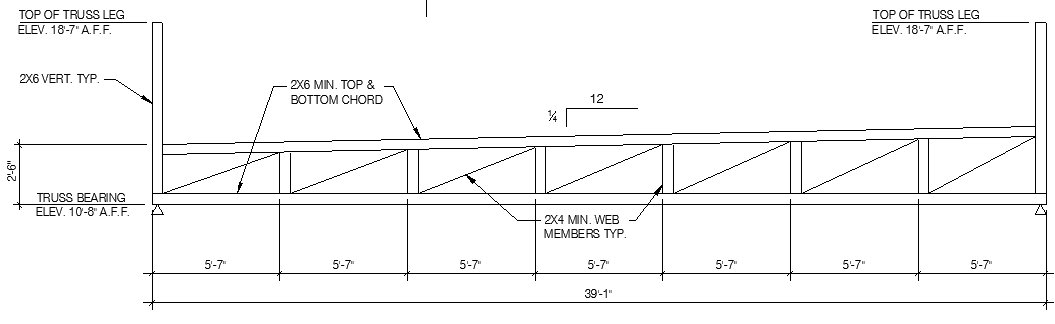
I have tried to attach a JPG image of the truss to this file but the Server
kicked it out. I have setup a web page link to a JPG image you can view to
see a schematic of the truss.

http://www.lewisengineering.com/RF_truss.jpg


As you can see from the image the truss is parallel chord with bottom chord
bearing. There is also a tall parapet that kind of cantilevers up. This is
for a chain restaurant. It came from a Prototype design. I assume this has
been built in several locations already but I don't see from the prototype
drawing how they accounted for the shear transfer from the diaphragm to the
shear walls and for the diaphragm chord force transfer. There is no
discernable load path from the roof sheathing to the shear wall.

Several have mentioned using coil strap anchors and I'm not sure I picture
what you are describing. If I understand correctly I would put solid
blocking between the trusses at the top chord. The sheathing would be
nailed to the blocking. I would add a strip of coil strapping on the top of
the sheathing that would act as the tension chord member. For the
compression chord I would consider the line of blocking between trusses as
adequate. Due to the parapet wind and the long narrow building my chord
force is over 8,000 pounds. I don't have a Simpson book with me now, but I
imagine this will be a hefty strap. I have not thought to use coil strapping
before, but then again I typically design top chord bearing or gable style
trusses and use the double top plate of the stud wall.

If I didn't have this parapet I could see this as being feasible. The
additional issue I see is getting the shear from the diaphragm into the
shear wall. Ideally the roof sheathing would stop at the inside face of
parapet wall so the sheets don't have to be cut. To get shear transfer I
think I need to require the sheets to be notched around the vertical parapet
stud and run my top chord blocking out at the exterior face of wall. For a
prototype, this seems to have been ignored by others.

Hopefully this JPG image will help provide additional insight and response
from the List.

Thanks again for your help.

Rich


******* ****** ******* ******** ******* ******* ******* ***
* Read list FAQ at: http://www.seaint.org/list_FAQ.asp
*
* This email was sent to you via Structural Engineers
* Association of Southern California (SEAOSC) server. To
* subscribe (no fee) or UnSubscribe, please go to:
*
*

http://www.seaint.org/sealist1.asp
*
* Questions to seaint-ad@seaint.org. Remember, any email you
* send to the list is public domain and may be re-posted
* without your permission. Make sure you visit our web
* site at: http://www.seaint.org

******* ****** ****** ****** ******* ****** ****** ********


******* ****** ******* ******** ******* ******* ******* ***
* Read list FAQ at: http://www.seaint.org/list_FAQ.asp
*
* This email was sent to you via Structural Engineers
* Association of Southern California (SEAOSC) server. To
* subscribe (no fee) or UnSubscribe, please go to:
*
*

http://www.seaint.org/sealist1.asp
*
* Questions to seaint-ad@seaint.org. Remember, any email you
* send to the list is public domain and may be re-posted
* without your permission. Make sure you visit our web
* site at: http://www.seaint.org
******* ****** ****** ****** ******* ****** ****** ********

RE: Diaphragm Chord Wood Roof

I appreciate the replies, especially on a Friday night. I wasn't expecting
answers until Monday.

I have tried to attach a JPG image of the truss to this file but the Server
kicked it out. I have setup a web page link to a JPG image you can view to
see a schematic of the truss.

http://www.lewisengineering.com/RF_truss.jpg


As you can see from the image the truss is parallel chord with bottom chord
bearing. There is also a tall parapet that kind of cantilevers up. This is
for a chain restaurant. It came from a Prototype design. I assume this has
been built in several locations already but I don't see from the prototype
drawing how they accounted for the shear transfer from the diaphragm to the
shear walls and for the diaphragm chord force transfer. There is no
discernable load path from the roof sheathing to the shear wall.

Several have mentioned using coil strap anchors and I'm not sure I picture
what you are describing. If I understand correctly I would put solid
blocking between the trusses at the top chord. The sheathing would be
nailed to the blocking. I would add a strip of coil strapping on the top of
the sheathing that would act as the tension chord member. For the
compression chord I would consider the line of blocking between trusses as
adequate. Due to the parapet wind and the long narrow building my chord
force is over 8,000 pounds. I don't have a Simpson book with me now, but I
imagine this will be a hefty strap. I have not thought to use coil strapping
before, but then again I typically design top chord bearing or gable style
trusses and use the double top plate of the stud wall.

If I didn't have this parapet I could see this as being feasible. The
additional issue I see is getting the shear from the diaphragm into the
shear wall. Ideally the roof sheathing would stop at the inside face of
parapet wall so the sheets don't have to be cut. To get shear transfer I
think I need to require the sheets to be notched around the vertical parapet
stud and run my top chord blocking out at the exterior face of wall. For a
prototype, this seems to have been ignored by others.

Hopefully this JPG image will help provide additional insight and response
from the List.

Thanks again for your help.

Rich


******* ****** ******* ******** ******* ******* ******* ***
* Read list FAQ at: http://www.seaint.org/list_FAQ.asp
*
* This email was sent to you via Structural Engineers
* Association of Southern California (SEAOSC) server. To
* subscribe (no fee) or UnSubscribe, please go to:
*
*

http://www.seaint.org/sealist1.asp
*
* Questions to seaint-ad@seaint.org. Remember, any email you
* send to the list is public domain and may be re-posted
* without your permission. Make sure you visit our web
* site at: http://www.seaint.org

******* ****** ****** ****** ******* ****** ****** ********

RE: Make sure you always wear your hardhat...

I more wonder about the construction of the "canopy" of the bank. That
thing went down AWFUL fast for what was likely not too much of a load
(relatively speaking)...and there did not seem to be too much of a
connection between the column/piers and the roof. The columns seemed to
"hinge" rather easily.

Regards,

Scott
Adrian, MI

-----Original Message-----
From: Michel Blangy [mailto:mblangy@satco-inc.com]
Sent: Friday, July 11, 2008 11:08 AM
To: Seaint@Seaint. Org
Subject: Make sure you always wear your hardhat...


at the atm??

http://www.break.com/index/how-not-to-use-the-drive-through-atm.html

******* ****** ******* ******** ******* ******* ******* ***
* Read list FAQ at: http://www.seaint.org/list_FAQ.asp
*
* This email was sent to you via Structural Engineers
* Association of Southern California (SEAOSC) server. To
* subscribe (no fee) or UnSubscribe, please go to:
*
*

http://www.seaint.org/sealist1.asp
*
* Questions to seaint-ad@seaint.org. Remember, any email you
* send to the list is public domain and may be re-posted
* without your permission. Make sure you visit our web
* site at: http://www.seaint.org

******* ****** ****** ****** ******* ****** ****** ********


******* ****** ******* ******** ******* ******* ******* ***
* Read list FAQ at: http://www.seaint.org/list_FAQ.asp
*
* This email was sent to you via Structural Engineers
* Association of Southern California (SEAOSC) server. To
* subscribe (no fee) or UnSubscribe, please go to:
*
*

http://www.seaint.org/sealist1.asp
*
* Questions to seaint-ad@seaint.org. Remember, any email you
* send to the list is public domain and may be re-posted
* without your permission. Make sure you visit our web
* site at: http://www.seaint.org

******* ****** ****** ****** ******* ****** ****** ********

Re: Location of Millhaven, Ontario, Canada

Gary, Alexander,

Thanks for your replies.

Regards,

H. Daryl Richardson

----- Original Message -----
From: "Gary L. Hodgson and Assoc." <ghodgson@bellnet.ca>
To: <seaint@seaint.org>
Sent: Saturday, July 12, 2008 6:35 AM
Subject: Re: Location of Millhaven, Ontario, Canada


> Alexander
> Bath is a village and you can consider Millhaven a suburb. The reason
> they list hotels is for families to stay there if visiting relatives or
> friends inside. It is about 10 to 15 minute drive west of Kingston, along
> the north shore of Lake Ontario- quite pretty.
> Gary
>
> Alexander Bausk wrote:
>> Daryl,
>>
>> It seems to be not a town but a maximum security prison near Bath at
>> the northeastern side of the lake of Ontario, in front of Amhert
>> island. Its coordinates are 44°12' N 76°45' W.
>>
>> All the toponyms that contain the word "Millhaven" (M. Street, M.
>> Stella and so on) seem to be located there. See Google maps for futher
>> info.
>>
>> Ironically, some online search indices treat Millhaven, ON as a town
>> or a neighborhood and even propose to book hotels there.
>>
>> Regards, Alex.
>>
>> On 7/12/08, Daryl Richardson <h.d.richardson@shaw.ca> wrote:
>>
>>> Fellow engineers,
>>>
>>> Can anyone tell me where Millhaven, Ontario, Canada is located?
>>> I
>>> can't seem to find it listed in any of my atlases.
>>>
>>> Thanks in advance.
>>>
>>> Regards,
>>>
>>> H. Daryl Richardson
>>>
>>
>>
>>
>
> ******* ****** ******* ******** ******* ******* ******* ***
> * Read list FAQ at: http://www.seaint.org/list_FAQ.asp
> * * This email was sent to you via Structural Engineers * Association
> of Southern California (SEAOSC) server. To * subscribe (no fee) or
> UnSubscribe, please go to:
> *
> *

http://www.seaint.org/sealist1.asp
> *
> * Questions to seaint-ad@seaint.org. Remember, any email you * send to
> the list is public domain and may be re-posted * without your
> permission. Make sure you visit our web * site at: http://www.seaint.org

> ******* ****** ****** ****** ******* ****** ****** ********

******* ****** ******* ******** ******* ******* ******* ***
* Read list FAQ at: http://www.seaint.org/list_FAQ.asp
*
* This email was sent to you via Structural Engineers
* Association of Southern California (SEAOSC) server. To
* subscribe (no fee) or UnSubscribe, please go to:
*
*

http://www.seaint.org/sealist1.asp
*
* Questions to seaint-ad@seaint.org. Remember, any email you
* send to the list is public domain and may be re-posted
* without your permission. Make sure you visit our web
* site at: http://www.seaint.org

******* ****** ****** ****** ******* ****** ****** ********

Re: Location of Millhaven, Ontario, Canada

Alexander
Bath is a village and you can consider Millhaven a suburb. The reason
they list hotels is for families to stay there if visiting relatives or
friends inside. It is about 10 to 15 minute drive west of Kingston,
along the north shore of Lake Ontario- quite pretty.
Gary

Alexander Bausk wrote:
> Daryl,
>
> It seems to be not a town but a maximum security prison near Bath at
> the northeastern side of the lake of Ontario, in front of Amhert
> island. Its coordinates are 44°12' N 76°45' W.
>
> All the toponyms that contain the word "Millhaven" (M. Street, M.
> Stella and so on) seem to be located there. See Google maps for futher
> info.
>
> Ironically, some online search indices treat Millhaven, ON as a town
> or a neighborhood and even propose to book hotels there.
>
> Regards, Alex.
>
> On 7/12/08, Daryl Richardson <h.d.richardson@shaw.ca> wrote:
>
>> Fellow engineers,
>>
>> Can anyone tell me where Millhaven, Ontario, Canada is located? I
>> can't seem to find it listed in any of my atlases.
>>
>> Thanks in advance.
>>
>> Regards,
>>
>> H. Daryl Richardson
>>
>
>
>

******* ****** ******* ******** ******* ******* ******* ***
* Read list FAQ at: http://www.seaint.org/list_FAQ.asp
*
* This email was sent to you via Structural Engineers
* Association of Southern California (SEAOSC) server. To
* subscribe (no fee) or UnSubscribe, please go to:
*
*

http://www.seaint.org/sealist1.asp
*
* Questions to seaint-ad@seaint.org. Remember, any email you
* send to the list is public domain and may be re-posted
* without your permission. Make sure you visit our web
* site at: http://www.seaint.org

******* ****** ****** ****** ******* ****** ****** ********

Re: Location of Millhaven, Ontario, Canada

Daryl,
Alexander gave you the right information. Everybody treats it like town
when it is really a suburb of Bath which you can put in your eye. Its
big claim to fame is that is where the maximum security prison is
located. It is all next to Kingston where they have more prisons
including the one I went to for four years-RMC.
Gary

Daryl Richardson wrote:
> Fellow engineers,
>
> Can anyone tell me where Millhaven, Ontario, Canada is
> located? I can't seem to find it listed in any of my atlases.
>
> Thanks in advance.
>
> Regards,
>
> H. Daryl Richardson

******* ****** ******* ******** ******* ******* ******* ***
* Read list FAQ at: http://www.seaint.org/list_FAQ.asp
*
* This email was sent to you via Structural Engineers
* Association of Southern California (SEAOSC) server. To
* subscribe (no fee) or UnSubscribe, please go to:
*
*

http://www.seaint.org/sealist1.asp
*
* Questions to seaint-ad@seaint.org. Remember, any email you
* send to the list is public domain and may be re-posted
* without your permission. Make sure you visit our web
* site at: http://www.seaint.org

******* ****** ****** ****** ******* ****** ****** ********

Friday, July 11, 2008

Re: Location of Millhaven, Ontario, Canada

Daryl,

It seems to be not a town but a maximum security prison near Bath at
the northeastern side of the lake of Ontario, in front of Amhert
island. Its coordinates are 44°12' N 76°45' W.

All the toponyms that contain the word "Millhaven" (M. Street, M.
Stella and so on) seem to be located there. See Google maps for futher
info.

Ironically, some online search indices treat Millhaven, ON as a town
or a neighborhood and even propose to book hotels there.

Regards, Alex.

On 7/12/08, Daryl Richardson <h.d.richardson@shaw.ca> wrote:
>
>
> Fellow engineers,
>
> Can anyone tell me where Millhaven, Ontario, Canada is located? I
> can't seem to find it listed in any of my atlases.
>
> Thanks in advance.
>
> Regards,
>
> H. Daryl Richardson


--
Alexander Bausk
CAD manager, Structural engineer at
Nuclear Engineering&Research Lab
Dnipropetrovsk, Ukraine

******* ****** ******* ******** ******* ******* ******* ***
* Read list FAQ at: http://www.seaint.org/list_FAQ.asp
*
* This email was sent to you via Structural Engineers
* Association of Southern California (SEAOSC) server. To
* subscribe (no fee) or UnSubscribe, please go to:
*
*

http://www.seaint.org/sealist1.asp
*
* Questions to seaint-ad@seaint.org. Remember, any email you
* send to the list is public domain and may be re-posted
* without your permission. Make sure you visit our web
* site at: http://www.seaint.org
******* ****** ****** ****** ******* ****** ****** ********

Location of Millhaven, Ontario, Canada

Fellow engineers,
 
        Can anyone tell me where Millhaven, Ontario, Canada is located?  I can't seem to find it listed in any of my atlases.
 
Thanks in advance.
 
Regards,
 
H. Daryl Richardson

RE: Wood / light frame shear walls without shear walls

One other issue has to do with the plan irregularity – if none exists and the residential building can conform to the International Building Code, then the use of hold downs on braced panels is not required to be evaluated so long as all other requirements of the Conventional Construction provisions are satisfied. In the past I did a comparison of numbers based on various roof dead loads and the resulting lateral loads that govern based on wind or seismic. I did this only for one story and found that in many cases for a home with a tile roof constructed on a slab on grade and an 8 or 10 plate height on with a geometric plan of 40-feet wide by about 60-feet in depth, there is an uplift calculated that the IRC seems to ignore. If this were treated as a full-compliance structure (prescriptive design ignored) then there would be sufficient uplift on the panel based on the 2:1 1997 UBC 2320 requirement for H/b. With the spacing of the panels at 25-feet and a tributary width of 20-feet there was an uplift over 1000-pounds that I calculated on a less than conservative dead load. Furthermore, the interior braced panels that required to be placed so that the spacing did not exceed 50-feet was not required by the code to be set on a foundation and the wall was still required to be anchored to the slab by at least 3-inch embedment into a 3-1/2” thick slab – which I found unusual in regions with high water tables that allowed some moisture to rise to the bottom of the slab or leak through the moisture vapor barrier.


When I presented this to the building Officials, the position was that if the code was wrong and missed the uplift or the thickness of the slab did not require a continuous foundation, he was not going to change it as he would have to guess at what the code writer had in mind to justify the issue. He was afraid that if he added the requirements for hold downs or for foundations on the interior braced panels he may be changing the performance of the structure and causing harm that was beyond his ability to understand. Therefore, he took the word of the code without question.


Another issue to consider is the age of the home and what the roof was originally designed for. Generally if it was designed for  a heavy clay tile (for example) and then changed to a light weight tile (5.5 psf vs. 12.0 psf) there may be less resistance to uplift. In this case, during the re-roof he ignored this topic in the prior code but will not demand engineering based on the new IBC requirements. His rational was that the old code only considered gravity load on prescriptive design, but that more consideration should be given to lateral load in the new code.


Just a few thoughts on the subject.


Dennis


From: ECVAl3@aol.com [mailto:ECVAl3@aol.com]
Sent: Tuesday, July 08, 2008 12:01 PM
To: seaint@seaint.org
Subject: Re: Wood / lightframe shear walls without shear walls


I see your point. If it is a nailed sill plate to the floor, I think the rocking of the shear wall would result mostly as partial plate nailing withdrawal (or are you referring to splitting along the edge at the shear ply nailing?). Splitting of the plate would be more likely with anchor bolts. Doesn't the requirement of the large square washers help in that case? Maybe a minimum requirement for the nailed plate to have a light strap or a plate at each end of the wall attaching to the rim joist would help.

SHM


In a message dated 7/8/2008 11:07:02 A.M. Pacific Daylight Time, Suresh.Acharya@ci.concord.ca.us writes:

SHM & erik_g,


Thanks for the input, but I was expecting discussion on minimizing non-ductile mode of failure due to splitting of sill plates which, if happens, would not qualify for R=6.5 (no yielding of nails here). CUREE-Caltech tests have shown much better performance of sill plates when holdowns were present. Rocking of wood shear walls are not welcome unlike concrete or CMU shear walls.


Regarding dead loads, tributary widths for resisting forces and seismic forces may not be necessarily same, but roof and ceiling dead loads are mostly lumped together in calculations. For example, ceiling joists and rafters spanning in different directions, or ceiling joists/rafters being supported by interior walls which are not shear walls, or due to presence of ceiling beams/ purlins/king posts etc.


Suresh Acharya, S.E.


Gas prices getting you down? Search AOL Autos for fuel-efficient used cars.

RE: Re-entrant Corner Question

Thanks Scott – this answers a question that has been troubling me for a while now. I am sorry not to have responded sooner – a death in the family has had me occupied most of the week as I tried to help my second cousin in Wisconsin arrange the funeral preparations from California (could not afford to fly back but expected the passing of my cousin who was 85 years old). I am just starting to get caught up and wanted to work on Multi-Lat™ and this issue related to plan irregularity needs to be considered for how the use of Omega (Overstrength Factor) and with Rho (Redundancy factor) is to be considered.


Thanks again,

Dennis


From: Scott Maxwell [mailto:smaxwell@umich.edu]
Sent: Sunday, July 06, 2008 6:47 PM
To: seaint@seaint.org
Subject: RE: Re-entrant Corner Question


I would say that you care about the re-entrant corners of the diaphragms.  If it is a one story building and the roof is rectangular even thought the outline of the buidling is L shaped or U shaped, then I would not consider it a plan irregularity typically.  If it is a multiple story building and the only the roof is rectangular (thus "regular") but other floors (thus diaphragms) at other levels are U shaped or L shaped (i.e. irregular), then you have a plan irregularity potentially.  It will also depend on if you have flexible diaphragms or not...and where the shearwalls are relative to the whole system.  I would argue that a U shaped building with a bunch of flexible diaphragms with appropriate shearwalls at the edges of the simple, flexible diaphragm might result in you realistically having a bunch of simple, rectangular flexible diaphragm segements which could result in the ability to treat it as a regular building.  To me, it is REALLY a matter of the specifics of the particular situation.


Regards,


Scott

Adrian, MI

-----Original Message-----
From: Dennis Wish [mailto:dennis.wish@verizon.net]
Sent: Sunday, July 06, 2008 6:04 PM
To: seaint@seaint.org
Subject: Re-entrant Corner Question

When determining a plan irregularity such as a re-entrant corner do you judge the irregularity by the geometry of the resisting walls or by the geometry of the roof? For example, if you have a “U” shaped structure with a rectangular roof that covers the entire lower floor, do you define the irregularity from the roof shape of walls in plan? If the roof is square or rectangular in plan over a building that is “U” shaped then what difference does it make if the courtyard entry to the building is set back so long as the roof does not lend itself to rotation. Hope this makes some sense.


Please let me know if you have any questions to answer this properly. TIA!


Dennis S. Wish, PE


Dennis S. Wish, PE

California Professional Engineer

dennis.wish@verizon.net

http://structuralist.wordpress.com

http://www.structuralist.net


Re: Diaphragm Chord Wood Roof

Rich Lewis wrote:
>
> I have a design and detail question. I'm working on a single story
> wood framed building with truss rafter roof. The lateral stability for
> wind is provided by wood sheathed shear walls. The trusses are
> parallel chord with bottom chord bearing. There is also a tall parapet
> that is part of the truss. At the face of wall the vertical member of
> the truss extends up to form the parapet.
>
Could you put blocking between the trusses below the sheathing but
inward of the vertical member for the parapet and then run strapping on
top of the sheathing? Your chord member would not be aligned with the
exterior wall but offset to the interior. If you switched to a top chord
bearing truss, your chord problem would be more straight forward, but
the parapet design would require some sort of wall on top of the
sheathing with staps on the front side to studs below and some sort of
Simpson LTT on the back side to either the trusses or blocking between
the trusses.

******* ****** ******* ******** ******* ******* ******* ***
* Read list FAQ at: http://www.seaint.org/list_FAQ.asp
*
* This email was sent to you via Structural Engineers
* Association of Southern California (SEAOSC) server. To
* subscribe (no fee) or UnSubscribe, please go to:
*
*

http://www.seaint.org/sealist1.asp
*
* Questions to seaint-ad@seaint.org. Remember, any email you
* send to the list is public domain and may be re-posted
* without your permission. Make sure you visit our web
* site at: http://www.seaint.org
******* ****** ****** ****** ******* ****** ****** ********

Re: Diaphragm Chord Wood Roof

You can block between each bottom bearing truss with studs on either side and sheathing to get your shear transfer. For each truss end, vertical stud on either side, horizontal blocking from bottom chord to bottom chord internailed to the the DBL top plate, and a horizontal block from top chord to top chord where the diaphragm nailing occurs.

Then put a coil strap on the outside of the sheathing to connect the blocking at the top chord together to create the chord. I would suggest using 3x for the blocking so you don't get any shiners.

Probably a skinny coil strap would do the trick.

Top chord bearing trusses are much better because of this very issue. Really no different than 2x rafters for the seismic load path.

HTH
-gm

On Fri, Jul 11, 2008 at 5:24 PM, Tarek Mokhtar <Tarekmokhtar@earthlink.net> wrote:
Rich,

Would a coil strap over plywood over blocking work?


Tarek Mokhtar, SE


I have a design and detail question.  I'm working on a single story wood framed building with truss rafter roof.  The lateral stability for wind is provided by wood sheathed shear walls.  The trusses are parallel chord with bottom chord bearing.  There is also a tall parapet that is part of the truss.  At the face of wall the vertical member of the truss extends up to form the parapet.

On previous typical truss rafter roofs using gable type trusses I design the top plate of the wall to be the chords of the diaphragm. I put in blocking between the trusses and transfer the shear down into the top plate of the wall.

On this project I'm wondering what is the best way to detail this so that the force comes out of the diaphragm and into the top plate of the wall, if that is possible.  If this is not practical, where else can I put the chord?  The end of the truss is 32" deep. The plywood sheathing will extend up to the top of parapet.   I thought about trying to run a ribbon at the sheathing level, but since I have this extension up for the parapet that does not seem feasible.

Anyone come across this problem before and have some creative solutions for designing and detailing the chords of the diaphragm?

Thanks for your help.

Rich


--


******* ****** ******* ******** ******* ******* ******* ***
*   Read list FAQ at: http://www.seaint.org/list_FAQ.asp
* *   This email was sent to you via Structural Engineers *   Association of Southern California (SEAOSC) server. To *   subscribe (no fee) or UnSubscribe, please go to:
*
*   http://www.seaint.org/sealist1.asp
*
*   Questions to seaint-ad@seaint.org. Remember, any email you *   send to the list is public domain and may be re-posted *   without your permission. Make sure you visit our web *   site at: http://www.seaint.org ******* ****** ****** ****** ******* ****** ****** ********

Diaphragm Chord Wood Truss Roof

Hi Rich:
 
Difficult problem.
 
The chord needs to be at the diaphragm, and the diaphragm is supported by wood trusses. 
 
An option is to switch to top chord bearing for your wood roof trusses.  This would allow you to use your conventional chords at the top plate level.  You would be looking at forming the parapet on top of the roof plywood using separate bracing, rather than having the truss folks include the parapet as part of the truss. 
 
This option would be conventional, easy to review, and easy to bid, and easy to get a permit.
 
Another approach may work.  It's unconventional You can keep the bottom chord truss bearing.  You may want to consider using fiber wrap (FRP).  Using several FRP layers on top of the plywood along the  edges of the plywood diaphragm would add the tensile capacity you need.  It would not interfere with the wood trusses, and would not be a huge waterproofing problem.  You may have blocking  for edge nailing on the edge of the plywood between the trusses.
 
Regards,
IDS Group Inc.
Bob Freeman, AIA, EIT
(949) 387-8500


Re: Diaphragm Chord Wood Roof

Rich,

Would a coil strap over plywood over blocking work?


Tarek Mokhtar, SE

>I have a design and detail question. I'm working on a single story
>wood framed building with truss rafter roof. The lateral stability
>for wind is provided by wood sheathed shear walls. The trusses are
>parallel chord with bottom chord bearing. There is also a tall
>parapet that is part of the truss. At the face of wall the vertical
>member of the truss extends up to form the parapet.
>
>On previous typical truss rafter roofs using gable type trusses I
>design the top plate of the wall to be the chords of the diaphragm.
>I put in blocking between the trusses and transfer the shear down
>into the top plate of the wall.
>
>On this project I'm wondering what is the best way to detail this so
>that the force comes out of the diaphragm and into the top plate of
>the wall, if that is possible. If this is not practical, where else
>can I put the chord? The end of the truss is 32" deep. The plywood
>sheathing will extend up to the top of parapet. I thought about
>trying to run a ribbon at the sheathing level, but since I have this
>extension up for the parapet that does not seem feasible.
>
>Anyone come across this problem before and have some creative
>solutions for designing and detailing the chords of the diaphragm?
>
>Thanks for your help.
>
>Rich
>


--

******* ****** ******* ******** ******* ******* ******* ***
* Read list FAQ at: http://www.seaint.org/list_FAQ.asp
*
* This email was sent to you via Structural Engineers
* Association of Southern California (SEAOSC) server. To
* subscribe (no fee) or UnSubscribe, please go to:
*
*

http://www.seaint.org/sealist1.asp
*
* Questions to seaint-ad@seaint.org. Remember, any email you
* send to the list is public domain and may be re-posted
* without your permission. Make sure you visit our web
* site at: http://www.seaint.org

******* ****** ****** ****** ******* ****** ****** ********

Diaphragm Chord Wood Roof

I have a design and detail question.  I’m working on a single story wood framed building with truss rafter roof.  The lateral stability for wind is provided by wood sheathed shear walls.  The trusses are parallel chord with bottom chord bearing.  There is also a tall parapet that is part of the truss.  At the face of wall the vertical member of the truss extends up to form the parapet.


On previous typical truss rafter roofs using gable type trusses I design the top plate of the wall to be the chords of the diaphragm.  I put in blocking between the trusses and transfer the shear down into the top plate of the wall. 


On this project I’m wondering what is the best way to detail this so that the force comes out of the diaphragm and into the top plate of the wall, if that is possible.  If this is not practical, where else can I put the chord?  The end of the truss is 32” deep. The plywood sheathing will extend up to the top of parapet.   I thought about trying to run a ribbon at the sheathing level, but since I have this extension up for the parapet that does not seem feasible.


Anyone come across this problem before and have some creative solutions for designing and detailing the chords of the diaphragm?


Thanks for your help.


Rich


RE: Pile splice question

Tarek:

I have done a similar work before for a project in Malibu where significant landslide forces had to be resisted by these 4 feet Dia. Piles.
I designed the top and bottom 20 feet of a 80 feet pile with reinforced concrete and the 40 feet middle with steel H section embedded in concrete pile. We did this for constructability issues and cost.
I extended the main perimeter rebars into the middle 40 feet. I also welded additional the A-706 rebars directly to the flanges of the steel H section.
My intention was to develop the rebar forces H section.

Regards
Casey (Khashayar) Hemmatyar
Private email: <khemmatyar AT hotmail.com>
 

-----Original Message-----
From: Tarek Mokhtar [mailto:Tarekmokhtar@earthlink.net]
Sent: Friday, July 11, 2008 12:31 PM
To: seaint@seaint.org
Subject: Pile splice question
I have steel H piles embedded in concrete caissons for a shoring job
that were delivered
a bit short. I would like to add the remainder in a spirally
reinforced section that would
extend up and lap with the H- pile a distance that I am trying to
figure out, would it be a rebar lap splice
or??
--
Tarek Mokhtar, SE
Laguna Beach,Ca
******* ****** ******* ******** ******* ******* ******* ***
*   Read list FAQ at: http://www.seaint.org/list_FAQ.asp
*
*   This email was sent to you via Structural Engineers
*   Association of Southern California (SEAOSC) server. To
*   subscribe (no fee) or UnSubscribe, please go to:
*
*   http://www.seaint.org/sealist1.asp
*
*   Questions to seaint-ad@seaint.org. Remember, any email you
*   send to the list is public domain and may be re-posted
*   without your permission. Make sure you visit our web
*   site at: http://www.seaint.org
******* ****** ****** ****** ******* ****** ****** ********
 

Pile splice question

I have steel H piles embedded in concrete caissons for a shoring job
that were delivered
a bit short. I would like to add the remainder in a spirally
reinforced section that would
extend up and lap with the H- pile a distance that I am trying to
figure out, would it be a rebar lap splice
or??
--

Tarek Mokhtar, SE
Laguna Beach,Ca

******* ****** ******* ******** ******* ******* ******* ***
* Read list FAQ at: http://www.seaint.org/list_FAQ.asp
*
* This email was sent to you via Structural Engineers
* Association of Southern California (SEAOSC) server. To
* subscribe (no fee) or UnSubscribe, please go to:
*
*

http://www.seaint.org/sealist1.asp
*
* Questions to seaint-ad@seaint.org. Remember, any email you
* send to the list is public domain and may be re-posted
* without your permission. Make sure you visit our web
* site at: http://www.seaint.org

******* ****** ****** ****** ******* ****** ****** ********

RE: PIle Cap Connection

Two approaches come to mind:
 
1.  Use the development length as required by the prestressed concrete manual
2.  Use a monostrand anchor as used in the post-tensioned concrete world.  You can go bonded or unbonded.  For bonded, you could use a piece of bonded duct, cast the cap, post tension the strand, and inject the space to create a bonded prestressed strand.  That would maintain a preload in the entire length of the strand into the cap and provide a positive anchor.  ...best of both worlds.  This is pretty common for post-tensioned bridges and parking structures.  Look at Dywidag or VSL web sites. 
 
Regards,
Harold Sprague

> Date: Thu, 10 Jul 2008 14:40:35 -0700
> From: arshadvali@yahoo.com
> Subject: PIle Cap Connection
> To: seaint@seaint.org
>
> Hello All,
>
> I have a unique situation where the piles could not be driven to it's full length and therefore had to be cut short. The Rebars at the top of the pile that would have been been used to develop the tension from the pile to the pile cap were lost in this process.
>
> My question is can I use the strands that were exposed from the pile to develop the tension into the pile cap? If so, what percentage of 270 ksi can I use for the tension capacity calculation? I would like to avoid drilling into the pile and epoxing rebar. Any thoughts or help would be appreciated.
>
> Thank you so kindly in advance.
>
> Arshad
>
>
>
>
> ******* ****** ******* ******** ******* ******* ******* ***
> * Read list FAQ at: http://www.seaint.org/list_FAQ.asp
> *
> * This email was sent to you via Structural Engineers
> * Association of Southern California (SEAOSC) server. To
> * subscribe (no fee) or UnSubscribe, please go to:
> *
> * http://www.seaint.org/sealist1.asp
> *
> * Questions to seaint-ad@seaint.org. Remember, any email you
> * send to the list is public domain and may be re-posted
> * without your permission. Make sure you visit our web
> * site at: http://www.seaint.org
> ******* ****** ****** ****** ******* ****** ****** ********


Need to know now? Get instant answers with Windows Live Messenger. IM on your terms.
RE: steel coupons

To be an "official" coupon test is a very large piece of steel per ASTM A 370.  It can be reduced in size.  I am away from the office so I do not have the exact sizes of the samples at hand, but I had to do the same thing on a project on the end of the Aleutian chain. 
 
You will need to get a good welder and a good inspector because after you remove the sample, you will have to weld in a repair patch (use 50 ksi steel).  Use a CJP weld for the patch.  Grind the weld flush, use ultrasonic testing to verify the CJP. 
 
I would suggest a double sided weld. 

Regards,
Harold Sprague

> Date: Fri, 11 Jul 2008 09:28:24 -0800
> From: dmorris@bbfm.com
> To: seaint@seaint.org
> Subject: steel coupons
>
> We have a project where we need to verify the yield stress of a steel
> moment frame for a premanufactured building. How big of a plate should
> be taken? Is there any available guidelines other than to take it from
> the web?
>
> ******* ****** ******* ******** ******* ******* ******* ***
> * Read list FAQ at: http://www.seaint.org/list_FAQ.asp
> *
> * This email was sent to you via Structural Engineers
> * Association of Southern California (SEAOSC) server. To
> * subscribe (no fee) or UnSubscribe, please go to:
> *
> * http://www.seaint.org/sealist1.asp
> *
> * Questions to seaint-ad@seaint.org. Remember, any email you
> * send to the list is public domain and may be re-posted
> * without your permission. Make sure you visit our web
> * site at: http://www.seaint.org
> ******* ****** ****** ****** ******* ****** ****** ********


The i'm Talkaton. Can 30-days of conversation change the world? Find out now.

RE: steel coupons

Drew,

See ASTM A370 for guidance. The samples should be taken from the
flanges.

Bill Scott

-----Original Message-----
From: Drew Morris [mailto:dmorris@bbfm.com]
Sent: Friday, July 11, 2008 9:28 AM
To: SEAINT
Subject: steel coupons

We have a project where we need to verify the yield stress of a steel
moment frame for a premanufactured building. How big of a plate should
be taken? Is there any available guidelines other than to take it from
the web?

******* ****** ******* ******** ******* ******* ******* ***
* Read list FAQ at: http://www.seaint.org/list_FAQ.asp
*
* This email was sent to you via Structural Engineers
* Association of Southern California (SEAOSC) server. To
* subscribe (no fee) or UnSubscribe, please go to:
*
*

http://www.seaint.org/sealist1.asp
*
* Questions to seaint-ad@seaint.org. Remember, any email you
* send to the list is public domain and may be re-posted
* without your permission. Make sure you visit our web
* site at: http://www.seaint.org

******* ****** ****** ****** ******* ****** ****** ********

******* ****** ******* ******** ******* ******* ******* ***
* Read list FAQ at: http://www.seaint.org/list_FAQ.asp
*
* This email was sent to you via Structural Engineers
* Association of Southern California (SEAOSC) server. To
* subscribe (no fee) or UnSubscribe, please go to:
*
*

http://www.seaint.org/sealist1.asp
*
* Questions to seaint-ad@seaint.org. Remember, any email you
* send to the list is public domain and may be re-posted
* without your permission. Make sure you visit our web
* site at: http://www.seaint.org
******* ****** ****** ****** ******* ****** ****** ********

steel coupons

We have a project where we need to verify the yield stress of a steel
moment frame for a premanufactured building. How big of a plate should
be taken? Is there any available guidelines other than to take it from
the web?

******* ****** ******* ******** ******* ******* ******* ***
* Read list FAQ at: http://www.seaint.org/list_FAQ.asp
*
* This email was sent to you via Structural Engineers
* Association of Southern California (SEAOSC) server. To
* subscribe (no fee) or UnSubscribe, please go to:
*
*

http://www.seaint.org/sealist1.asp
*
* Questions to seaint-ad@seaint.org. Remember, any email you
* send to the list is public domain and may be re-posted
* without your permission. Make sure you visit our web
* site at: http://www.seaint.org

******* ****** ****** ****** ******* ****** ****** ********

RE: Fibers in Composite Slab

I would consider using steel fibers on a slab on deck or slab on grade in lieu of synthetic fibers, but I would insist on a test placement before I would recommend it on a large scale placement.  There is a learning curve.  Steel fiber concrete batches differently and pumps differently.  I agree that concrete finishers will not have a problem once they gain familiarity. 

But it will not result in a big savings especially if there is a lack of familiarity.  Any hard bids will have a familiarity factor.  No one wants to be surprised. 
 
I would advise a test pour, and a preconstruction meeting to include all of the stake holders including the vendors, ready mix provider, finisher, testing lab, special inspectors, etc.  I would also suggest that you consider belt conveyors as opposed to pumps. 
 
A lot of ready mix companies are carrying belt conveyors on their trucks.  They do not need to prime with grout, and the mix is placed without changes like air content.  (Overhead pumping can reduce the air content and slump depending on the height and angle of the boom.) 
 
I would also request that a vibrating screed like a Copperhead be used in lieu of hand rodding. 

Regards,
Harold Sprague

> Subject: RE: Fibers in Composite Slab
> Date: Fri, 11 Jul 2008 08:51:49 -0400
> From: mmotchos@sw-sc.com
> To: seaint@seaint.org
>
> ANSI/SDI-C1.0 Standard for composite steel floor deck (2007) now allows
> the substitution of steel fibers meeting ASTM A820 at a minimum dosage
> rate of 25lb/cy or macro (as opposed to micro) synthetic fiber of
> polyolefin with an equivalent diameter of between .4 and 1.25mm with a
> min aspect ratio of 50 at a dosage rate of 4lb/cy
> This only replaces temp-shrink so any negative reinforcing over the
> girders, or reentrant corner bars would still be needed.
> I seem to recall something relating to the synthetic fibers and
> fire-rating still not having been tested/resolved the last time I
> looked, but that work may be complete by now.
> I commonly allow the option to substitute a blend of Steel fibers with a
> micro synthetic fiber (such as Novomesh 850) for the WWF but
> surprisingly few even consider that option until we really start pushing
> that the wwf must be chaired into position. I was reasonably pleased
> with one project that did use the steel fibers (with additional mild
> steel for corners and girders). There did seem to be a little more
> issue with crack width at reentrant corners but I am not wholly
> convinced the corner bars were consistently installed prior to the pour.
> There seemed to be a little more frequent, but tight, cracks on the
> surface but since all of the area was to be under tile or carpet this
> was not a concern in our case. I think the real benefits come in safety
> (walking on properly chaired WWF is nearly impossible) and the notion
> that the reinforcing is throughout the cross-section, instead of hoping
> that the WWF winds up in the right place.
> I just had a second composite one placed with the steel fiber blend last
> week, but have not gotten by to get a look at it yet. I have not tried
> specifying one using just synthetic macro fibers or a fully synthetic
> blend.
>
> Despite their initial concerns on the first one about finishing, I did
> not hear that any problems occurred and there was nothing apparent on
> the surface. This goes for using them in slab-on-grade as well which I
> have seen more of.
>
>
> Michelle Motchos, PE
> Stevens & Wilkinson of South Carolina, Inc.
> Columbia, SC
>
> -----Original Message-----
> From: Adam Vakiener [mailto:avakiener@southernae.com]
> Sent: Friday, July 11, 2008 7:18 AM
> To: SEAINT
> Subject: RE: Fibers in Composite Slab
>
> Does anybody out there have any experience with using fiber
> reinforcement in an elevated composite slab? We've got a project that
> has come in way over budget, and the contractor has suggested that we
> could save some money by taking out the welded wire fabric and just
> using fibers. Given the situation, we'd like to entertain the thought,
> but none of us here have done it, so we don't have any comfort level
> with it and aren't particularly thrilled to have this $100 million
> project as the test case.
>
> If you've tried this, did you use synthetic fibers, steel fibers, or a
> mixture? How were the results? Were there finishing problems?
> Cracking? If we go with fiber, we're planning on keeping rebar over the
> girders to control cracking in the negative moment region - would you
> agree that this is good practice? Any other considerations?
>
> Thanks.
>
> -- Joel
>
>
>
>
> ******* ****** ******* ******** ******* ******* ******* ***
> * Read list FAQ at: http://www.seaint.org/list_FAQ.asp
> *
> * This email was sent to you via Structural Engineers
> * Association of Southern California (SEAOSC) server. To
> * subscribe (no fee) or UnSubscribe, please go to:
> *
> * http://www.seaint.org/sealist1.asp
> *
> * Questions to seaint-ad@seaint.org. Remember, any email you
> * send to the list is public domain and may be re-posted
> * without your permission. Make sure you visit our web
> * site at: http://www.seaint.org
> ******* ****** ****** ****** ******* ****** ****** ********


Need to know now? Get instant answers with Windows Live Messenger. IM on your terms.

Re: Fibers in Composite Slab

Joel,
 
        Most people I've worked with think that fiber reinforcing is just fine PROVIDED you use the same amount of "ordinary" steel reinforcing that you would use without the fiber reinforcing.  This seems in keeping with what some others are saying.
 
        That said, switching to fiber reinforcing to save money on a $100,000,000 job seems like trying to reduce the dead load by using thinner coats of paint!  To really save money you will need to look at the "big money" items. My suggestions would be to check architectural finishes, mechanical equipment, or general project layouts and specifications.
 
        Another likely problem area is the budget itself may be unrealistic.  Consultants often have difficulty in preparing accurate budget estimates, in large part because the suppliers know that the consultants are not the paying customers so they won't provide the best pricing input.
 
        Good luck.
 
Regards,
 
Daryl
----- Original Message -----
Sent: Thursday, July 10, 2008 5:19 PM
Subject: Fibers in Composite Slab

Does anybody out there have any experience with using fiber reinforcement in an elevated composite slab?  We've got a project that has come in way over budget, and the contractor has suggested that we could save some money by taking out the welded wire fabric and just using fibers.  Given the situation, we'd like to entertain the thought, but none of us here have done it, so we don't have any comfort level with it and aren't particularly thrilled to have this $100 million project as the test case.


If you've tried this, did you use synthetic fibers, steel fibers, or a mixture?  How were the results?  Were there finishing problems?  Cracking?  If we go with fiber, we're planning on keeping rebar over the girders to control cracking in the negative moment region – would you agree that this is good practice?  Any other considerations?


Thanks.


-- Joel


Joel Adair   PE
Structural Engineer


SHW
GROUP
P 214.473.2400 Dallas
D 214.473.2528
F 214.473.2529
shwgroup.com


NOTICE:
This e-mail transmission is intended only for the use of the individual or entity named above and may contain information that is confidential, privileged, and/or exempt from disclosure under applicable law. If you are not the intended recipient, you are hereby notified that any review, disclosure, copying, distribution, or other use of any of the information contained in this transmission is strictly prohibited. If you have received this transmission in error, please immediately notify the sender by e-mail at the above address and delete it from your computer system; you should not copy the message or disclose its contents to anyone. The content of the message and or attachments may not reflect the view and opinions of the originating company or any party it is representing.


RE: Fibers in Composite Slab

Let me join the other experienced engineers who warn against this. Reducing traditional reinforcing which has been proven over many decades is foolish.

Stan Scholl

Civil Engineer with over 50 yrs. experience

RE: fibers in composite slab

Andrew –


You wrote, “…explain why, using case study as a valid reason so you don't look like you are just being overly conservative.”  That’s exactly what I’m trying to do.  Do you have any specifics of the slab with the previous employer that had the problems?  Harold’s comment and yours (both of which I respect) unfortunately amount only to, “I saw one of those slabs once that had real problems.”  How can I possibly use that to make an informed decision without knowing any of the details?  It certainly underscores the fact that I need to be cautious in making my recommendation, but doesn’t provide any real evidence one way or the other.  How do I know that our experience won’t be more like what Michelle Motchos had?  (Thank you, Michelle, for sharing your experience.)  Were the problem slabs that you and Harold saw built in the early days of synthetic micro fiber?  Does Michelle’s recent success indicate that maybe the fiber developers have finally developed something that works in the various configurations of steel fibers, macro synthetics, or steel/synthetic blends?  That’s what I need to figure out.


We’re going to talk to the concrete sub to see if they can show us any local projects in which they used fibers in this application.  To me, that would be the most compelling factor in making a decision.


Thanks again for your input, and if you can provide any more information regarding what went into the slab that had problems, so we know what NOT to do, I’d appreciate it very much.


-- Joel


From: Andrew Kester, P.E. [mailto:akester@cfl.rr.com]
Sent: Friday, July 11, 2008 10:05 AM
To: seaint
Subject: re: fibers in composite slab


With all due respect, I read this part fo the post aloud to the other engineer in my office for discussion/humor purposes:

"the contractor has suggested that we
could save some money by taking out the welded wire fabric and just
using fibers"


The contractor will actually be making more money, because he will have a repair job in a couple of weeks and you may be getting a bill or worse... I completely agree with Harold. A previous employer did it on one job and they had all kinds of cracking. I think even with composite stl deck and bars over negative regions and at reentrant corners, there are too many other "accidental" tensile forces (in addition to negative bending and shrinkage) in a deck+slab system to not have steel reinforcement, WWR at a min.


My answer would be NO WAY! And stick to your guns but explain why, using case study as a valid reason so you don't look like you are just being overly conservative. And a $100M building they probably have a few more areas of budget concern than your WWR.... I would think that would be a very minor cost anyway.


Andrew Kester, P.E.
Principal/Project Manager
ADK Structural Engineering, PLLC
1510 E. Colonial Drive, Suite 301
Orlando, FL 32803

NOTICE:
This e-mail transmission is intended only for the use of the individual or entity named above and may contain information that is confidential, privileged, and/or exempt from disclosure under applicable law. If you are not the intended recipient, you are hereby notified that any review, disclosure, copying, distribution, or other use of any of the information contained in this transmission is strictly prohibited. If you have received this transmission in error, please immediately notify the sender by e-mail at the above address and delete it from your computer system; you should not copy the message or disclose its contents to anyone. The content of the message and or attachments may not reflect the view and opinions of the originating company or any party it is representing.


Make sure you always wear your hardhat...

at the atm??

http://www.break.com/index/how-not-to-use-the-drive-through-atm.html

******* ****** ******* ******** ******* ******* ******* ***
* Read list FAQ at: http://www.seaint.org/list_FAQ.asp
*
* This email was sent to you via Structural Engineers
* Association of Southern California (SEAOSC) server. To
* subscribe (no fee) or UnSubscribe, please go to:
*
*

http://www.seaint.org/sealist1.asp
*
* Questions to seaint-ad@seaint.org. Remember, any email you
* send to the list is public domain and may be re-posted
* without your permission. Make sure you visit our web
* site at: http://www.seaint.org

******* ****** ****** ****** ******* ****** ****** ********

re: fibers in composite slab

With all due respect, I read this part fo the post aloud to the other engineer in my office for discussion/humor purposes:
"the contractor has suggested that we
could save some money by taking out the welded wire fabric and just
using fibers"
 
The contractor will actually be making more money, because he will have a repair job in a couple of weeks and you may be getting a bill or worse... I completely agree with Harold. A previous employer did it on one job and they had all kinds of cracking. I think even with composite stl deck and bars over negative regions and at reentrant corners, there are too many other "accidental" tensile forces (in addition to negative bending and shrinkage) in a deck+slab system to not have steel reinforcement, WWR at a min.
 
My answer would be NO WAY! And stick to your guns but explain why, using case study as a valid reason so you don't look like you are just being overly conservative. And a $100M building they probably have a few more areas of budget concern than your WWR.... I would think that would be a very minor cost anyway.
 
 
Andrew Kester, P.E.
Principal/Project Manager
ADK Structural Engineering, PLLC
1510 E. Colonial Drive, Suite 301
Orlando, FL 32803

RE: Fibers in Composite Slab

ANSI/SDI-C1.0 Standard for composite steel floor deck (2007) now allows
the substitution of steel fibers meeting ASTM A820 at a minimum dosage
rate of 25lb/cy or macro (as opposed to micro) synthetic fiber of
polyolefin with an equivalent diameter of between .4 and 1.25mm with a
min aspect ratio of 50 at a dosage rate of 4lb/cy
This only replaces temp-shrink so any negative reinforcing over the
girders, or reentrant corner bars would still be needed.
I seem to recall something relating to the synthetic fibers and
fire-rating still not having been tested/resolved the last time I
looked, but that work may be complete by now.
I commonly allow the option to substitute a blend of Steel fibers with a
micro synthetic fiber (such as Novomesh 850) for the WWF but
surprisingly few even consider that option until we really start pushing
that the wwf must be chaired into position. I was reasonably pleased
with one project that did use the steel fibers (with additional mild
steel for corners and girders). There did seem to be a little more
issue with crack width at reentrant corners but I am not wholly
convinced the corner bars were consistently installed prior to the pour.
There seemed to be a little more frequent, but tight, cracks on the
surface but since all of the area was to be under tile or carpet this
was not a concern in our case. I think the real benefits come in safety
(walking on properly chaired WWF is nearly impossible) and the notion
that the reinforcing is throughout the cross-section, instead of hoping
that the WWF winds up in the right place.
I just had a second composite one placed with the steel fiber blend last
week, but have not gotten by to get a look at it yet. I have not tried
specifying one using just synthetic macro fibers or a fully synthetic
blend.

Despite their initial concerns on the first one about finishing, I did
not hear that any problems occurred and there was nothing apparent on
the surface. This goes for using them in slab-on-grade as well which I
have seen more of.


Michelle Motchos, PE
Stevens & Wilkinson of South Carolina, Inc.
Columbia, SC

-----Original Message-----
From: Adam Vakiener [mailto:avakiener@southernae.com]
Sent: Friday, July 11, 2008 7:18 AM
To: SEAINT
Subject: RE: Fibers in Composite Slab

Does anybody out there have any experience with using fiber
reinforcement in an elevated composite slab? We've got a project that
has come in way over budget, and the contractor has suggested that we
could save some money by taking out the welded wire fabric and just
using fibers. Given the situation, we'd like to entertain the thought,
but none of us here have done it, so we don't have any comfort level
with it and aren't particularly thrilled to have this $100 million
project as the test case.

If you've tried this, did you use synthetic fibers, steel fibers, or a
mixture? How were the results? Were there finishing problems?
Cracking? If we go with fiber, we're planning on keeping rebar over the
girders to control cracking in the negative moment region - would you
agree that this is good practice? Any other considerations?

Thanks.

-- Joel


******* ****** ******* ******** ******* ******* ******* ***
* Read list FAQ at: http://www.seaint.org/list_FAQ.asp
*
* This email was sent to you via Structural Engineers
* Association of Southern California (SEAOSC) server. To
* subscribe (no fee) or UnSubscribe, please go to:
*
*

http://www.seaint.org/sealist1.asp
*
* Questions to seaint-ad@seaint.org. Remember, any email you
* send to the list is public domain and may be re-posted
* without your permission. Make sure you visit our web
* site at: http://www.seaint.org
******* ****** ****** ****** ******* ****** ****** ********

Re: CMU piers & columns vs WALL

Andrew,
I ran into this problem on a job where another engineer criticized my
design. So I sought advice from the Canadian Portland Cement Assoc'n (
now Concrete Assoc of Canada) and their advice was that if the column or
wall can take all of the axial and shear loads as plain masonry or
concrete then it does not need to meet the code requirements for
reinforced concrete columns. The moment forces just make it a beam.
Best of luck.
Gary

Andrew Kester, P.E. wrote:
> This topic came up a few weeks ago, and I have some situations I am
> reviewing that have caused me to thoroughly study ACI 530...
>
> Simply defined by geometry:
> column: isolated vertical member with a width< 3*t
> pier: 3*t < width < 6*t
>
> So for 8" block, an 8x8 thru 8x24 member is column, and up to an 8x48
> member is a pier, if it is an ISOLATED member, of which I have not
> found a definition. My thinking is if the member is used as a column
> to support a carport, canopy, porch, etc. and is out there by itself,
> it is ISOLATED. But if you have a wall with two openings to each side,
> and it is 16" wide and supports pre-cast lintels to each side as part
> of a wall system, then is this isolated? My opinion is no.
>
> What I am getting at is that if it is considered a column you have to
> supply (4) vert bars and lateral ties, tough to do in a 8x16 or 8x24
> block column, since you would have to have ties at 8" oc vert also.
> Really tough to build. The commentary says the column requirements are
> based on ACI concrete column requirements, and are there to provide
> confinement to prevent the vert bars from buckling, and for shear
> reinforcement. But what if I am not using the rebar for compression
> and the grouted masonry easily can carry the axial load, and there is
> no shear going into the pier? Is it really a column or acting as a
> column as I believe the Code's intention to be??
>
> Besides my isolated member example, which is a cause of concern, are
> wall elements that meet the geometry requirements required to be
> designed as columns? If so, this means a min of 4 bars and ties inside
> a wall. I have never seen this done in Florida (non seismic), and was
> never instructed to design it this way. In most of my projects, CMU
> bearing walls are normally rather lightly loaded in axial compression
> (low rise), the rebar is there for out of plane wind loading and
> eccentric gravity loading, and thus they would not be treated as
> columns or piers but as wall elements....
>
> My calcs in all cases show the wall segment, pier, or column (whatever
> it is) works for combined axial (light and carried by masonry only)
> and flexural compression, and I do not use the steel for anything but
> flexural reinforcement so I do not see a need for 4 bars, lateral
> ties, or shear reinforcement.
>
> Thoughts and input would be appreciated!
>
> Andrew
>
>
>
> Andrew Kester, P.E.
> Principal/Project Manager
> ADK Structural Engineering, PLLC
> 1510 E. Colonial Drive, Suite 301
> Orlando, FL 32803

******* ****** ******* ******** ******* ******* ******* ***
* Read list FAQ at: http://www.seaint.org/list_FAQ.asp
*
* This email was sent to you via Structural Engineers
* Association of Southern California (SEAOSC) server. To
* subscribe (no fee) or UnSubscribe, please go to:
*
*

http://www.seaint.org/sealist1.asp
*
* Questions to seaint-ad@seaint.org. Remember, any email you
* send to the list is public domain and may be re-posted
* without your permission. Make sure you visit our web
* site at: http://www.seaint.org

******* ****** ****** ****** ******* ****** ****** ********

RE: Fibers in Composite Slab

Does anybody out there have any experience with using fiber
reinforcement in an elevated composite slab? We've got a project that
has come in way over budget, and the contractor has suggested that we
could save some money by taking out the welded wire fabric and just
using fibers. Given the situation, we'd like to entertain the thought,
but none of us here have done it, so we don't have any comfort level
with it and aren't particularly thrilled to have this $100 million
project as the test case.

If you've tried this, did you use synthetic fibers, steel fibers, or a
mixture? How were the results? Were there finishing problems?
Cracking? If we go with fiber, we're planning on keeping rebar over the
girders to control cracking in the negative moment region - would you
agree that this is good practice? Any other considerations?

Thanks.

-- Joel


The SDI specification for composite steel form deck requires a minimum
amount of shrinkage reinforcement equal to 0.00075 times the area of
concrete above the deck. I have heard some fiber manufacturer's claim
that their product is a replacement for this reinforcing. However, I
see no mention of this in the SDI specification.

--

Adam Vakiener, P.E.
Structural Engineer
Southern A&E, LLC

******* ****** ******* ******** ******* ******* ******* ***
* Read list FAQ at: http://www.seaint.org/list_FAQ.asp
*
* This email was sent to you via Structural Engineers
* Association of Southern California (SEAOSC) server. To
* subscribe (no fee) or UnSubscribe, please go to:
*
*

http://www.seaint.org/sealist1.asp
*
* Questions to seaint-ad@seaint.org. Remember, any email you
* send to the list is public domain and may be re-posted
* without your permission. Make sure you visit our web
* site at: http://www.seaint.org

******* ****** ****** ****** ******* ****** ****** ********

Thursday, July 10, 2008

RE: PIle Cap Connection

In the past I have seen people use un stressed tendon in concrete diaphragms for collectors and drags.  The problem is that unstressed tendon is a lot more flexxible than stressed tendon or mild steel.  I will suggest that the provisions in the code are for tendons that are stressed.
I believe that the classical fix for your problem is to drill into the end of the pile and install mild steel bars embedded in epoxy grout.
Mark Gilligan

******* ****** ******* ******** ******* ******* ******* ***
* Read list FAQ at: http://www.seaint.org/list_FAQ.asp
*
* This email was sent to you via Structural Engineers
* Association of Southern California (SEAOSC) server. To
* subscribe (no fee) or UnSubscribe, please go to:
*
*

http://www.seaint.org/sealist1.asp
*
* Questions to seaint-ad@seaint.org. Remember, any email you
* send to the list is public domain and may be re-posted
* without your permission. Make sure you visit our web
* site at: http://www.seaint.org
******* ****** ****** ****** ******* ****** ****** ********

RE: Fibers in Composite Slab

I have seen synthetic fibers used in one elevated slab on metal composite deck.  It resulted in one of the most expensive repairs on a new project that I have ever seen.  There were big cracks everywhere.  Crack epoxy injection at $6/ft and the patching and grinding of the concrete cost 100's of times more than the percieved savings.  And the fiber vendor ran for cover. 

Regards,
Harold Sprague


Subject: Fibers in Composite Slab
Date: Thu, 10 Jul 2008 18:19:36 -0500
From: jadair@shwgroup.com
To: seaint@seaint.org


Does anybody out there have any experience with using fiber reinforcement in an elevated composite slab?  We've got a project that has come in way over budget, and the contractor has suggested that we could save some money by taking out the welded wire fabric and just using fibers.  Given the situation, we'd like to entertain the thought, but none of us here have done it, so we don't have any comfort level with it and aren't particularly thrilled to have this $100 million project as the test case.


If you've tried this, did you use synthetic fibers, steel fibers, or a mixture?  How were the results?  Were there finishing problems?  Cracking?  If we go with fiber, we're planning on keeping rebar over the girders to control cracking in the negative moment region – would you agree that this is good practice?  Any other considerations?


Thanks.


-- Joel


Joel Adair   PE
Structural Engineer


SHW
GROUP
P 214.473.2400 Dallas
D 214.473.2528
F 214.473.2529
shwgroup.com


NOTICE:
This e-mail transmission is intended only for the use of the individual or entity named above and may contain information that is confidential, privileged, and/or exempt from disclosure under applicable law. If you are not the intended recipient, you are hereby notified that any review, disclosure, copying, distribution, or other use of any of the information contained in this transmission is strictly prohibited. If you have received this transmission in error, please immediately notify the sender by e-mail at the above address and delete it from your computer system; you should not copy the message or disclose its contents to anyone. The content of the message and or attachments may not reflect the view and opinions of the originating company or any party it is representing.


Making the world a better place one message at a time. Check out the i'm Talkathon.